
Edge Intelligence & Generative Architectures: Next-Gen Patterns for AI-Driven Development in 2026
2026 demands more than just App Router patterns. MindsCraft explores how AI agents, semantic caching, and predictive observability redefine data orchestration, mutations, and authentication in the era of generative applications.
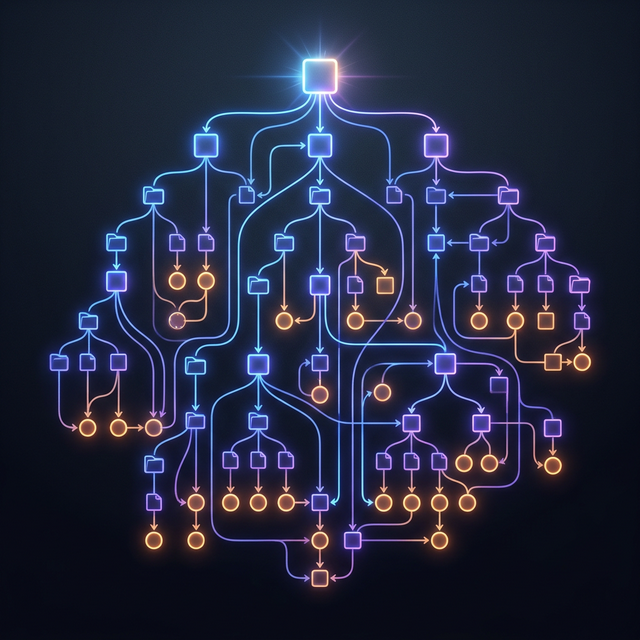
The year is 2026. The pace of innovation hasn't just accelerated; it's undergone a quantum shift. Traditional software engineering patterns, while foundational, are now merely baselines upon which an entirely new paradigm of AI-driven development is being built. At MindsCraft, we've navigated this complex landscape across dozens of advanced deployments, revealing that the true differentiator lies in orchestrating edge intelligence, generative models, and proactive systems.
Where a few years ago we optimized for React Server Components and explicit caching, today we design for AI agent interoperability, semantic data layers, and continuous, adaptive user experiences. This post delves into the advanced patterns and architectural shifts essential for building resilient, high-performance, and truly intelligent applications in 2026.
The Core Shift: From Reactive Logic to Proactive Intelligence
Our journey at MindsCraft has shown us that the most significant transformation isn't just about integrating AI; it's about shifting from reactive application logic to proactive, predictive intelligence. Every traditional pillar—data fetching, mutations, caching, authorization, and error handling—is now being re-architected with AI at its core, anticipating user needs and self-optimizing system behavior.
Key Takeaway: The AI-Native Application
In 2026, a truly 'AI-native' application isn't just one that uses AI; it's one where AI influences every layer, from infrastructure provisioning to front-end rendering, providing hyper-personalized, context-aware experiences with unprecedented efficiency and resilience.
AI-Enhanced Data Orchestration: Beyond the 'Fetch'
The days of simple API calls are a relic. Our 2026 applications demand dynamic, context-aware data fetching, often involving multiple AI models to refine and personalize the payload.
Semantic Data Layers & Edge Pre-computation
We're no longer just fetching raw data. Instead, AI models deployed at the edge pre-process and enrich data, performing semantic analysis and predictive filtering *before* it even hits the client or the main application server. This reduces bandwidth, improves perceived latency, and personalizes content with surgical precision.
"At MindsCraft, our next-gen data fetching patterns often involve a 'Semantic Data Proxy' layer. This isn't just a cache; it's an intelligent agent that understands the user's intent, predicts future data needs, and orchestrates calls across various microservices and foundational models, delivering a tailored data stream, not a raw firehose."
React Server Components (RSCs) remain a powerful primitive, but their role has evolved. They now serve as the orchestration layer for these edge-intelligent data streams, ensuring only the most relevant, AI-processed information flows into the component tree.
Intelligent Mutations & Agentic Server Actions
Server Actions, once a groundbreaking way to bridge client and server logic, are now evolving into triggers for complex AI agentic workflows. A user's input no longer directly translates to a database write; it initiates a chain of intelligent decisions.
Intent-Based Interaction & Proactive Validation
User input is first parsed by an LLM-powered intent recognition service. This service not only validates the structural integrity (where Zod still plays a vital role) but also the *semantic intent* behind the action. If a user tries to 'book a flight to Mars,' the system immediately understands this requires more than a simple date validation; it triggers a conversation or suggests alternatives, often *before* a traditional server action even fires.
Traditional Server Action (2023)
- Direct call to API endpoint.
- Validation (e.g., Zod) on input.
- Executes database write/read.
- Returns simple success/error.
Agentic Server Action (2026)
- User intent parsed by LLM.
- Semantic validation & contextual re-routing.
- Orchestrates multiple AI micro-agents.
- May trigger proactive user feedback.
- Returns structured, AI-enriched outcome.
Our patterns at MindsCraft emphasize returning richer, contextual feedback, often including AI-generated suggestions or clarifications, instead of just { success, error, data }. Errors, when they occur, are rarely just 'validation failed'; they're 'intent misaligned' or 'agent workflow interrupted,' with AI offering immediate mitigation paths.
Hyper-Contextual Caching: The Predictive Edge
Caching in 2026 is less about explicit `revalidatePath` or `revalidateTag` and more about predictive, personalized, and semantic management by AI.
Predictive & Semantic Caching Networks
AI models analyze user behavior, session context, and content trends to proactively pre-fetch and cache data at the edge. This isn't just simple preloading; it's a deep understanding of what a user *might* need next, down to the granular component level. Cache invalidation is also AI-driven, understanding the 'semantic freshness' of data rather than relying solely on time-to-live or explicit triggers.
"We're leveraging federated cache networks where multiple AI-driven services intelligently share and update cached content, minimizing redundant fetches across a distributed system. The AI decides not just *what* to cache, but *where* and for *whom*, adapting in real-time."
For highly dynamic dashboards, our approach involves a 'delta-caching' strategy, where only the critical, most recent changes are streamed, with AI models reconciling the state client-side. This keeps user interfaces responsive without sacrificing data accuracy.
Adaptive Security & Proactive Auth Flows
Authorization in 2026 is no longer a static gate; it's a continuous, adaptive process, deeply integrated with AI for behavioral analysis and zero-trust principles.
Passwordless, Biometric-First & Continuous Authentication
The industry standard for authentication has shifted almost entirely to passwordless methods, leveraging biometrics (facial recognition, fingerprint scans, voiceprints) and device-level attestations. Beyond initial login, AI-powered behavioral biometrics continuously monitor user interactions, identifying anomalous patterns that could indicate a session hijack or unauthorized access.
"Our architectures embed AI-driven 'continuous authentication' layers. If a user's typing rhythm, mouse movements, or interaction patterns deviate significantly from their established profile, the system can dynamically request re-authentication or restrict access to sensitive features, often without interrupting the user's flow."
Zero-Trust architectures are amplified by AI, creating micro-segmented access policies that adapt in real-time based on user context, device posture, and historical behavior, minimizing the blast radius of any potential breach.
AI-Powered Observability & Self-Healing Systems
Error handling in 2026 moves beyond returning helpful messages to proactive detection, root cause analysis, and even self-correction, all driven by advanced AI.
Generative Error Explanation & Proactive Anomaly Detection
When an error does occur, AI doesn't just log it; it analyzes the context across logs, traces, and metrics to provide generative, human-readable explanations, often suggesting direct remediation steps for developers. Furthermore, AI models constantly monitor system health, detecting anomalies *before* they manifest as user-facing errors.
"Imagine an error `500` being caught, and within milliseconds, an AI agent not only tells you *which* microservice failed and *why*, but also suggests a specific code snippet fix, or even initiates a rollback to a stable state, all while notifying the relevant engineering team."
Our MindsCraft systems are increasingly incorporating 'self-healing' components. Minor deviations or temporary service degradations are often autonomously addressed by AI agents, re-routing traffic, restarting services, or adjusting resource allocation, ensuring a remarkably resilient user experience.
The impact on UX is profound: applications become incredibly stable, errors are rare, and when they do occur, they are resolved with minimal user perception, reinforcing a sense of reliability and intelligence.
MindsCraft's Vision: Crafting the AI-Native Future
The transition to AI-driven development isn't just an evolution; it's a fundamental re-imagining of how software is built and interacts with the world. At MindsCraft, we're at the forefront of this revolution, designing and implementing architectures where AI is not an add-on but the very fabric of the application.
Our expertise spans the orchestration of complex AI agent networks, the development of semantic data layers, and the engineering of hyper-resilient, self-optimizing systems. We believe that the premium software of 2026 and beyond will be defined by its intelligence, adaptability, and seamless user experience, crafted with precision and a deep understanding of the AI frontier. Let's build the future, together.
MindsCraft Builds This
Want us to build this for your product?
We've shipped Web Development solutions for startups and scale-ups. Let's talk about yours.
Start a conversation