

How Large Language Models are Reshaping B2B Software Architectures
The business-to-business (B2B) software landscape is in the midst of a profound transformation, driven by the rapid evolution and adoption of Large Language Models (LLMs). Once confined to research labs, LLMs have matured into powerful, versatile tools capable of understanding, generating, and processing human language with unprecedented accuracy and nuance. This shift is not merely an incremental improvement; it represents a fundamental rethinking of how B2B applications are designed, developed, and deployed. For software architects and engineering leaders, understanding this paradigm shift is crucial for building resilient, intelligent, and future-proof enterprise solutions.

The Paradigm Shift: From Rules-Based Logic to Generative Intelligence
Traditionally, B2B software architectures have relied heavily on explicit rules, structured databases, and predefined workflows. Business logic was meticulously coded, and any deviation required direct human intervention or extensive development cycles. While effective for predictable processes, this approach often struggled with unstructured data, nuanced decision-making, and dynamic user requirements.
LLMs introduce a new dimension: generative intelligence. Instead of following explicit rules, they learn intricate patterns from vast datasets, enabling them to infer, extrapolate, and generate contextually relevant outputs. This capability allows B2B applications to move beyond rigid automation towards more adaptive, intelligent, and human-like interactions. Architects are now grappling with integrating these probabilistic, non-deterministic components into highly deterministic enterprise systems, demanding new approaches to system design, data flow, and error handling.

Key Areas of LLM Impact on B2B Software Architectures
1. Enhanced Data Processing and Insights
B2B enterprises churn through enormous volumes of data, much of which is unstructured (documents, emails, contracts, customer feedback). LLMs excel at processing this data, extracting key information, summarizing complex texts, and identifying hidden patterns. This capability fundamentally alters how data pipelines are conceived.

Intelligent Document Processing (IDP): LLMs can interpret invoices, legal documents, and reports, automating data entry and validation with greater accuracy than traditional OCR and rules-based systems. This reduces manual effort in finance, legal, and HR departments.
Semantic Search and Knowledge Discovery: Moving beyond keyword matching, LLMs enable semantic search, allowing users to query enterprise knowledge bases using natural language and receive highly relevant, synthesized answers. This accelerates research and decision-making.
Predictive Analytics and Anomaly Detection: By analyzing textual data alongside structured metrics, LLMs can uncover subtle signals indicative of market trends, customer sentiment shifts, or operational inefficiencies, augmenting traditional analytical models.
2. Intelligent Automation and Workflow Orchestration
LLMs are transforming Robotic Process Automation (RPA) and business process management (BPM) by injecting intelligence into previously rigid workflows.

Dynamic Workflow Adaptation: Instead of fixed decision trees, LLMs can analyze context to route requests, prioritize tasks, and even suggest optimal next steps in a workflow, adapting to real-time changes.
Automated Task Execution: From drafting initial email responses in customer support to generating preliminary code for software development, LLMs can automate segments of tasks, freeing up human resources for more complex problem-solving.
Process Mining Augmentation: LLMs can analyze process logs and unstructured human feedback to identify bottlenecks and suggest improvements with a deeper understanding of qualitative factors.
3. Personalized User Experiences and Adaptive Interfaces
B2B software often suffers from complex interfaces tailored for "power users." LLMs enable more intuitive, personalized interactions.
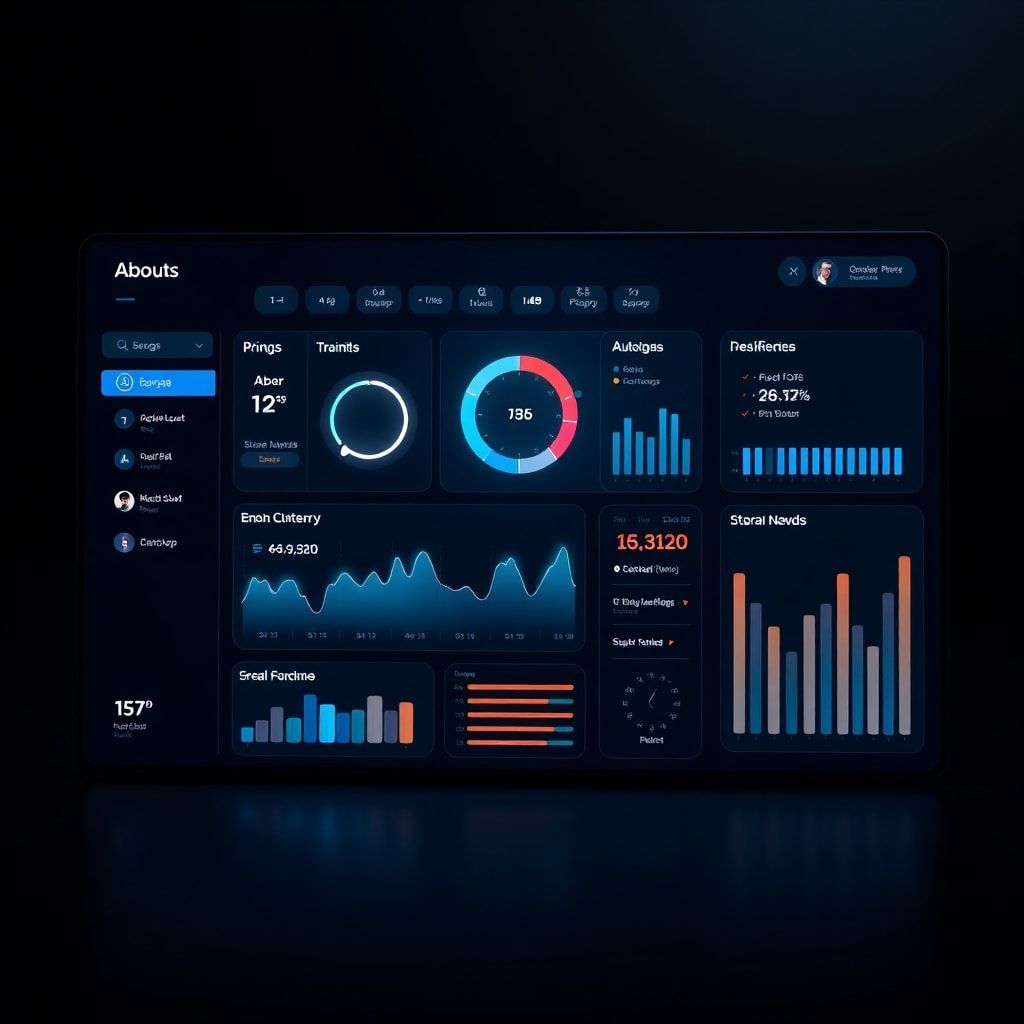
Adaptive Dashboards: LLMs can personalize dashboard views based on user roles, historical queries, and current business context, surfacing the most relevant information proactively.
Contextual Recommendations: Whether recommending products in an e-commerce platform or suggesting relevant documents in a CRM, LLMs provide highly context-aware recommendations, improving user efficiency and satisfaction.
Proactive Assistance: LLM-powered agents can anticipate user needs, offer in-app guidance, or flag potential issues before they become critical, acting as an intelligent co-pilot within the application.
4. Advanced Conversational Interfaces and Natural Language Understanding
The advent of sophisticated chatbots and virtual assistants is perhaps the most visible impact of LLMs in B2B.

Intelligent Customer Support: LLM-powered chatbots can handle complex queries, provide detailed solutions, and even escalate to human agents with rich context, significantly reducing response times and improving service quality.
Internal Knowledge Management: Employees can query internal databases, policy documents, and operational guides using natural language, making critical information more accessible and reducing reliance on traditional search tools.
Voice-Enabled Interactions: Integrating LLMs with speech-to-text and text-to-speech technologies enables hands-free operation of B2B applications, particularly beneficial in field service, manufacturing, or logistics.
5. Generative Capabilities for Content and Code
LLMs are not just for understanding; they are powerful generators.

Automated Content Creation: From drafting marketing copy and product descriptions to generating reports and internal communications, LLMs can accelerate content generation pipelines.
Code Generation and Assistance: Developers can leverage LLMs for code completion, bug detection, refactoring suggestions, and even generating entire boilerplate code snippets, significantly boosting developer productivity. This shifts the developer's role from writing every line of code to guiding and refining AI-generated outputs.
Architectural Considerations and Challenges in an LLM-Integrated B2B Landscape
Integrating LLMs into existing B2B architectures introduces several complex considerations that demand careful planning and execution.

1. Integration Strategies and Modularity
Architects must decide how LLMs fit into their existing microservices or monolithic structures. Common strategies include:
API Integration: The most common approach involves consuming LLM capabilities as a service via APIs (e.g., OpenAI, Anthropic, Google Cloud AI). This offers scalability and rapid deployment but introduces external dependencies and data egress concerns.
Retrieval-Augmented Generation (RAG): For domain-specific tasks, RAG architectures combine LLMs with proprietary knowledge bases. This involves a retriever component that fetches relevant internal documents, which are then passed to the LLM as context for generation. This minimizes hallucinations and keeps sensitive data within organizational boundaries.
Fine-tuning: While resource-intensive, fine-tuning pre-trained LLMs on proprietary datasets can tailor their behavior and knowledge more precisely for specific B2B use cases, albeit at higher operational costs and complexity.
Local/On-premise Deployment: For extreme data sensitivity or low-latency requirements, smaller LLMs (or open-source models) can be deployed on-premise or within a private cloud, requiring significant infrastructure investment and MLOps expertise.
The architecture needs to support a modular approach, allowing different LLMs to be swapped in or out, or even chained together (e.g., one LLM for summarization, another for translation). Orchestration layers are critical here.
2. Scalability, Performance, and Latency
LLM inferences can be computationally intensive and incur significant latency, especially for larger models. B2B applications often demand real-time responsiveness.
Asynchronous Processing: For non-critical tasks, architects can design asynchronous workflows where LLM inferences happen in the background.
Caching Mechanisms: Caching common LLM responses or intermediate results can reduce redundant calls and improve perceived performance.
Batching and Parallelization: Grouping multiple requests or parallelizing inference across multiple GPUs can optimize resource utilization.
Model Optimization: Techniques like quantization, pruning, and distillation can reduce model size and accelerate inference times, making models more suitable for edge or constrained environments.
3. Data Privacy, Security, and Compliance
Handling sensitive B2B data with LLMs presents paramount security and compliance challenges (GDPR, HIPAA, SOC2).
Data Sanitization and Anonymization: Strict protocols for cleaning and anonymizing sensitive data before it reaches an LLM (especially third-party APIs) are essential.
Access Control and Encryption: Robust access controls for LLM endpoints and encryption of data in transit and at rest are non-negotiable.
Auditing and Logging: Comprehensive logging of all LLM interactions, prompts, and responses is critical for debugging, compliance, and post-incident analysis.
Data Residency: Ensuring data remains within specified geographical boundaries is often a regulatory requirement, influencing deployment choices (cloud region, on-premise).
4. Cost Management
The operational costs of running and integrating LLMs can be substantial, particularly with usage-based API models or dedicated GPU infrastructure.
Token Optimization: Efficient prompt engineering to minimize token usage per query is crucial.
Tiered LLM Usage: Employing smaller, more cost-effective models for simpler tasks and reserving larger, more powerful models for complex queries.
Monitoring and Budgeting: Implementing robust cost monitoring and alerting systems to prevent unexpected expenditures.
5. Ethical AI, Bias Mitigation, and Explainability
LLMs can inherit biases from their training data, leading to unfair or discriminatory outputs. For B2B, this can have significant reputational and legal consequences.
Bias Detection and Mitigation: Implementing frameworks to detect and mitigate bias in LLM outputs.
Human-in-the-Loop (HITL): Designing systems where human oversight and validation are integral, especially for critical decisions.
Explainability (XAI): While challenging with LLMs, efforts to provide some level of transparency or "reasoning" behind LLM outputs are increasingly important for trust and auditing.
6. Observability and Monitoring
Traditional monitoring tools often fall short for LLM-integrated systems. New metrics and approaches are needed.
Prompt/Response Tracking: Monitoring the quality, relevance, and safety of LLM outputs.
Latency and Throughput: Tracking performance metrics specific to LLM inference.
Cost Metrics: Monitoring API token usage and associated expenditures.
Hallucination Detection: Developing mechanisms to detect and flag instances where LLMs generate factually incorrect or nonsensical information.
Technical Deep Dive: Illustrative Architectural Patterns
Retrieval-Augmented Generation (RAG) for Contextual B2B AI
RAG has emerged as a dominant pattern for grounding LLMs in proprietary enterprise data. It addresses the "hallucination" problem and avoids the expensive process of fine-tuning for every new piece of information.

# Conceptual RAG Workflow Snippetclass RAGSystem: def __init__(self, vector_db, llm_api_client): self.vector_db = vector_db # e.g., Pinecone, Weaviate, ChromaDB self.llm_api_client = llm_api_client # e.g., OpenAI, Anthropic def query(self, user_query: str, top_k: int = 3) -> str: # 1. Embed the user query query_embedding = self.llm_api_client.embed(user_query) # 2. Retrieve relevant documents from the vector database # These documents are typically pre-indexed and embedded from enterprise knowledge base retrieved_docs = self.vector_db.search(query_embedding, k=top_k) context = "\n\n".join([doc.text for doc in retrieved_docs]) # 3. Construct a prompt with retrieved context prompt = f"Based on the following context, answer the question:\n\nContext:\n{context}\n\nQuestion: {user_query}" # 4. Generate response using the LLM response = self.llm_api_client.generate(prompt) return response.text# Example Usage (conceptual)# rag_system = RAGSystem(my_enterprise_vector_db, openai_client)# answer = rag_system.query("What is the Q3 sales forecast for the EMEA region?")# print(answer)This architecture decouples the knowledge base from the LLM, allowing for real-time updates to proprietary data without requiring retraining of the LLM. It's a powerful pattern for building enterprise-grade intelligent assistants, knowledge workers, and data analysts.
Fine-tuning vs. Prompt Engineering: A Strategic Choice
Architects must weigh the trade-offs between prompt engineering and fine-tuning:

Prompt Engineering: Involves crafting specific instructions, examples (few-shot learning), and context within the input prompt to guide the LLM's output. It's cost-effective for diverse tasks and rapid iteration, relying on the LLM's broad pre-trained knowledge.
Fine-tuning: Involves further training a pre-trained LLM on a smaller, domain-specific dataset. This tailors the model's weights to a particular task, style, or vocabulary, resulting in more consistent and accurate outputs for niche use cases, often with shorter prompts. However, it's more expensive, requires significant data, and is less agile for adapting to rapidly changing information.
A hybrid approach is often optimal: use prompt engineering for general tasks and consider fine-tuning for critical, highly specialized functions where precision and consistency are paramount.
Deployment Patterns: Cloud, On-Premise, and Hybrid
The choice of deployment significantly impacts control, cost, and compliance:

Cloud-based LLM APIs: Easiest to implement, offering high scalability and minimal infrastructure overhead. Best for non-sensitive data or when data can be fully anonymized. Challenges include data egress costs and vendor lock-in.
Private Cloud/On-premise LLMs: For stringent security, data residency, or specific latency requirements. Requires significant MLOps expertise, GPU infrastructure, and ongoing maintenance. Often involves open-source LLMs or smaller commercial models.
Hybrid Architectures: A common approach where sensitive data processing or core logic remains on-premise, while less sensitive or general tasks leverage cloud LLMs. This balances security with agility and cost-effectiveness.
The Future Outlook for LLM-Driven B2B Architectures
The trajectory of LLM integration into B2B software is clear: deeper, more pervasive, and increasingly sophisticated. Future architectures will likely feature:

Autonomous Agents: LLM-powered agents capable of planning, executing multi-step tasks, and interacting with various B2B systems autonomously.
Multi-modal AI: Integration of LLMs with computer vision and audio processing to create truly intelligent systems that understand and generate across different data types.
Personalized Foundation Models: Enterprises may develop their own smaller, highly specialized foundation models tailored to their unique business domain and data, offering a competitive advantage.
Robust Trust and Safety Layers: Enhanced frameworks for ensuring fairness, transparency, and security will become standard, addressing the inherent risks of generative AI.
Conclusion
Large Language Models are not just another feature; they are a foundational technology that is fundamentally reshaping B2B software architectures. From intelligent automation and personalized experiences to advanced data insights and generative capabilities, LLMs empower enterprises to build more adaptive, efficient, and intelligent applications. While significant architectural challenges remain in areas such as scalability, data privacy, and ethical AI, the benefits of embracing LLMs are too substantial to ignore. Software architects who proactively understand and integrate these powerful models will be instrumental in driving the next wave of innovation in the B2B landscape, creating systems that are not just functional, but truly intelligent and transformative.